
What Is the Egg Freezing Process Step by Step?
Egg vitrification (freezing) is a simple medical procedure. The process usually lasts between 10 and 15 days, from the start of ovarian hormonal stimulation to egg retrieval and vitrification.
Índice
Initial tests and medical evaluation
Any patient interested in preserving her fertility through egg vitrification (cryopreservation) is first offered an initial consultation with a specialist in reproductive medicine. During this visit, the doctor carefully reviews all relevant information from the patient’s medical, surgical and family history, as well as details about her gynaecological history, previous pregnancies and menstrual cycle (regularity, presence of pain, etc.).
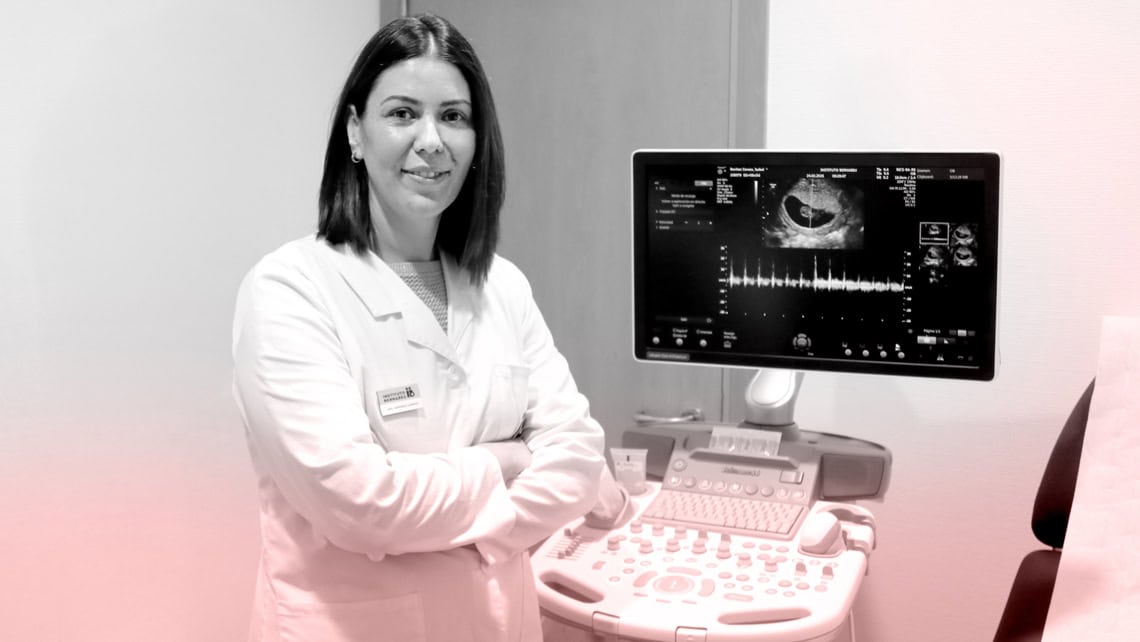
Once this information has been collected, a transvaginal ultrasound scan is performed to assess the condition of the uterus and ovaries and to carry out an antral follicle count (also known as ovarian reserve).
Ovarian reserve mainly depends on the patient’s age, but it can also be influenced by genetic factors, previous ovarian surgery or the presence of certain ovarian conditions.
Blood tests are then performed, including Anti-Müllerian Hormone (AMH) levels, which provide an important indicator of the patient’s ovarian reserve. This test can be carried out at any stage of the menstrual cycle and does not require fasting. It helps determine whether the patient’s ovarian reserve is high, normal, low or very low.
Before starting the egg vitrification treatment, the patient must also undergo pre-operative blood tests and serology screening (hepatitis B and C, syphilis and HIV). In specific cases, additional tests may be required, such as baseline hormone testing or genetic studies, depending on the findings from the first consultation.
Ovarian stimulation
All women are born with the follicles (the structures from which eggs develop) that they will have for the rest of their lives.
As a woman ages, her ovarian reserve gradually decreases. However, from the age of 35–36, this decline becomes much faster, both in terms of the number and quality of eggs, which naturally affects the probability of pregnancy.
Under natural conditions, hormones produced by the pituitary gland (FSH and LH) stimulate the growth of one follicle per menstrual cycle. Midway through the cycle, this follicle releases an egg into the fallopian tube, where fertilisation by sperm may occur.
During the egg vitrification process, the patient undergoes ovarian stimulation with hormonal medication to promote the growth of several follicles in each ovary during the same cycle. This allows several eggs to be retrieved and preserved for future use.
The number of follicles stimulated with medication will depend on each patient’s initial ovarian reserve.
Ovarian stimulation usually lasts between 10 and 15 days (although this may vary between patients) and involves daily subcutaneous injections, which are simple to administer.
Side effects from the medication are generally mild. The most common include abdominal bloating, headache and emotional sensitivity during the stimulation period.
Ultrasound monitoring and follicular tracking
During ovarian stimulation, regular ultrasound scans are carried out to monitor the number of follicles developing, their size and the most appropriate moment for egg retrieval.
Each case is individualised, but patients usually require around 3–4 ultrasound scans, depending on the rate of follicular growth.
Induction of egg maturation (Trigger shot)
At the end of ovarian stimulation, a final injection known as the “trigger shot” is administered to induce the maturation of the eggs so they can be retrieved and vitrified. The medication used is personalised according to each patient.
The trigger injection is usually administered 36 hours before ovarian puncture (egg retrieval).
Egg retrieval or follicular puncture
Follicular puncture is a minor outpatient surgical procedure performed in an operating room under light general anaesthesia (sedation).
The patient is sedated for approximately 15–30 minutes, depending on the number of follicles present in both ovaries.
Follicular aspiration is performed vaginally under ultrasound guidance using a fine aspiration needle. No incisions or sutures are required. Through this needle, the follicular fluid from each stimulated follicle in both ovaries is aspirated.
The collected follicular fluid is then transported to the In Vitro Fertilisation laboratory, where embryologists locate each retrieved egg under a microscope and place them individually to confirm the total number of eggs obtained.
Vitrification: ultra-rapid freezing
Once the total number of retrieved eggs has been confirmed, the next step is to determine how many of them are mature, meaning they have reached the second stage of cell division known as metaphase II.
Eggs in metaphase II are suitable for vitrification.
Eggs in metaphase I are not initially suitable for freezing and undergo an in vitro maturation process. If they mature to metaphase II, they may then be vitrified. If they remain in metaphase I, they are discarded.
Any oocyte in a stage earlier than metaphase I is directly discarded.
All metaphase II eggs are frozen using a technique called vitrification, an ultra-rapid freezing method that lowers the egg’s temperature from 37°C to −196°C within seconds using liquid nitrogen and cryoprotectants.
Cryoprotectants (special culture media) are used to prevent the formation of ice crystals that could damage the egg’s cellular structures.
This technique allows eggs to remain frozen indefinitely without deterioration. They do not expire and their quality is preserved. Egg survival after the vitrification and warming process is above 90%, although it always varies depending on the patient’s age at the time the eggs were frozen.
| Phase | Main activity | Estimated time |
|---|---|---|
| First consultation | Collection of medical history, patient information and ultrasound scan | 1 hour |
| Hormonal stimulation | Daily injections | 10–15 days |
| Monitoring visits | Blood tests and ultrasound scans | 3–4 visits |
| Ovarian puncture | Egg aspiration under sedation | 15–30 minutes |
| Recovery | Relative rest | 24 hours |
Where can you freeze your eggs?
At Instituto Bernabeu, we help women freeze their eggs so they can decide when the right moment to become a mother is, supported by the experience and excellence of a team that is a leader in reproductive medicine.
Below you can find the different Instituto Bernabeu clinics where you can undergo treatment, all of them offering the same medical, technological and human standards that define Instituto Bernabeu.






Dr. Verónica Legidos López, Instituto Bernabeu Elche.