
Instituto Bernabeu presents advances in genetic diagnosis at the 5th Interdisciplinary Congress on Human Genetics.
15-04-2026
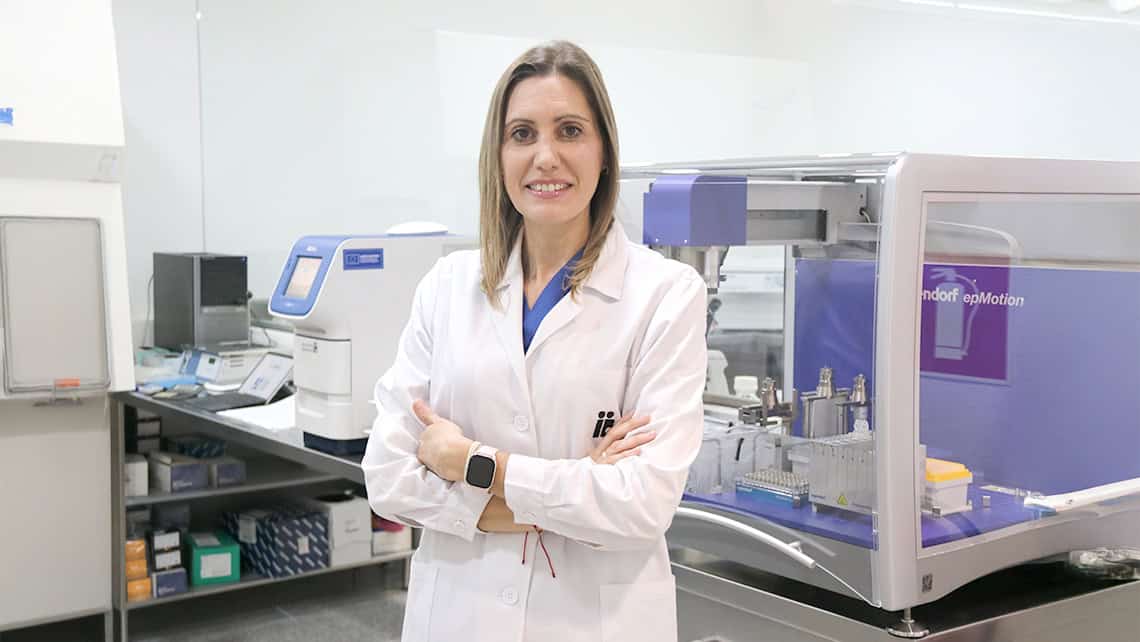
The 5th Interdisciplinary Congress on Human Genetics, held in Granada, has brought together genetics experts to address the latest advances in the diagnosis and treatment of diseases of genetic origin. In this framework, Paqui Lozano García, a biochemist at Instituto Bernabeu, has presented research focused on improving the genetic diagnosis of infertility, especially in cases of implantation failure and recurrent miscarriage.
Optical Genome Mapping: a new tool in infertility
Francisca María Lozano García, a biochemist at Instituto Bernabeu, has presented a study on the use of Optical Genome Mapping (OGM), a high-resolution technology that allows for the detection of chromosomal alterations that are not visible through conventional cytogenetics. Structural chromosomal alterations are one of the main causes of infertility, as well as recurrent gestational loss and implantation failures in assisted reproduction treatments. However, many of these alterations remain undiagnosed with standard techniques.
In this study, conducted on 395 patients undergoing assisted reproduction treatments, the use of OGM allowed for the identification of hidden structural variants in 8.1% of cases with a normal karyotype. These alterations include inversions, translocations, and insertions, as well as small deletions in genes associated with fertility.
Improving diagnosis in implantation failure and recurrent miscarriage
The study results show that the use of Optical Genome Mapping improves genetic diagnosis in patients with:
- Recurrent implantation failure (RIF)
- Recurrent miscarriage (RPL)
- Unexplained infertility
Additionally, a higher rate of embryonic aneuploidy and poorer seminal quality were observed in those patients with alterations detected through OGM, which reinforces the importance of a more precise genetic diagnosis. This advance allows for the identification of previously unknown genetic causes and facilitates the personalization of assisted reproduction treatments, optimizing the chances of success.
Toward a more precise genetic diagnosis in assisted reproduction
The incorporation of technologies such as Optical Genome Mapping represents a step forward in precision reproductive medicine. As the study concludes, this tool could be especially useful in patients with infertility without a diagnosis after conventional genetic studies, allowing for a more complete evaluation before starting treatment.
Although its application is not yet routine in fertility clinics, its potential to detect hidden genetic anomalies opens new pathways to improve the diagnosis and treatment of infertility. Instituto Bernabeu continues to bet on research and innovation with the goal of offering its patients a more precise diagnosis, personalized treatments, and better reproductive outcomes.